
There’s been a lot of chatter around Cryotherapy lately, especially among athletes seeking faster recovery times or celebrities looking to burn extra calories. But is there research to back up these claims, or is Cryotherapy just an expensive way to cold plunge? The short answer: yes. There’s real science behind the chill.
There are two main types of Cryotherapy: Local and Whole Body.
Local Cryotherapy involves applying controlled cold exposure to a specific region, usually through vapours of nitrogen at around -256 °F. This type of concentrated treatment can help reduce pain and the need for postoperative analgesics by lowering tissue temperature and slowing nerve conduction.1 Whole Body Cryotherapy, on the other hand, involves stepping into a Cryo Chamber of sub-zero air where temperatures drop below −166 °F (or less) for two to three minutes.2
While the body of research on Cryotherapy is still growing, several studies have shown substantial promise in its ability to support recovery and overall well-being. These benefits include reducing inflammation and muscle recovery time,3 as well as improving energy, mood and sleep.
In this article, we’ll break down what the benefits of Cryotherapy are and explore what the latest research says about how it can help your body feel restored from the inside out.
Highlights
- Controlled cold helps calm inflammation and speed tissue repair.
- Cryotherapy can help reduce soreness, balance stress hormones and support recovery.
- Cryotherapy activates your body’s natural pain-relief and endorphin systems.
- Consistent use may enhance circulation, immune function and sleep quality.
1. Healing Support
When your body is in “repair mode”, whether that’s from an injury, surgery or just a brutal gym session, it’s fighting hard to try and get you back to full strength.
For starters, inflammation and oxidative stress naturally rise as part of the healing process—it’s your immune system's way of clearing out damaged cells and laying the groundwork for repair.4 The problem, however, arises when that inflammation sticks around for too long. Instead of helping, it can start to slow down tissue regeneration, prolonging your recovery time.
That’s where a little bit of controlled cold can make a big difference.
Research shows that Whole-Body Cryotherapy has the potential to lower pro-inflammatory IL-1β and boost anti-inflammatory IL-10.3 In other words, Whole Body Cryotherapy helps calm an overactive immune response so your body can focus on rebuilding tissue instead of fighting inflammation.
In fact, one study found that 68.4% of patients with spinal degenerative joint diseases experienced complete pain relief after a Cryotherapy-based rehabilitation program.5
2. Improved Athletic Recovery
One of the main reasons why Whole Body Cryotherapy is such a popular recovery treatment for athletes is because it can help your body bounce back faster between training sessions and reduce Delayed Onset Muscle Soreness (DOMS).6
The way it works is that Cryotherapy helps lower cortisol (the stress hormone) while increasing testosterone and growth factors (the ones that actually rebuild muscle).7 This process may help to reduce muscle fatigue and speed up tissue repair.
Recent research has found that this process is especially effective when you use Cryotherapy soon after an intense training session. In one study, participants who completed a downhill run and used Whole Body Cryotherapy within an hour maintained 94.4% of their baseline strength, compared to just 89% when treatment was delayed.8
At the same time, Cryotherapy can also help to support your antioxidant defense system. How? By reducing the oxidative stress that slows muscle repair. Studies show it even lowers muscle-damage markers, like creatine kinase (CK) and lactate dehydrogenase (LDH), both of which spike after tough workouts.9
That means you can experience faster recovery, better strength retention and more energy to keep pushing toward your next training goal.
3. Reduced Pain and Inflammation
From a physiological standpoint, Whole Body Cryotherapy may help to reduce pain in two main ways: by activating your endogenous analgesic system (your body’s natural pain-relief network)10 and by slowing nerve conduction velocity in pain fibers.11
In other words, Cryotherapy can help slow down the passage of pain signals to your brain, giving your body a chance to reset its pain threshold and calm overactive nerve pathways.
That’s why Cryotherapy is increasingly being used to help manage chronic pain. For example, clinical trials in people with rheumatic diseases such as rheumatoid arthritis and ankylosing spondylitis have shown significant reductions in pain scores, with the most benefit seen at temperatures below –110 °C.11
Cryotherapy may also help to lower systemic inflammation and support long-term recovery.
Back in 2024, we conducted a RestoreLabs study that followed 15 healthy adults over nine months to see how regular Whole Body Cryotherapy affected inflammation levels. Participants who completed about six to seven sessions per month showed steady reductions in high-sensitivity C-reactive protein (hsCRP), a key marker of systemic inflammation.12
As Dr. Rachele Pojednic, Restore’s Chief Science Officer, explains: “Our study adds to the growing evidence that Whole Body Cryotherapy can be a powerful tool for managing systemic inflammation—even in healthy individuals.”
4. Immune‑System Modulation
Cryotherapy works on the principle of hormesis—the idea that exposing your body to short, controlled doses of stress can actually make your body stronger. Just like lifting weights challenges your muscles to adapt, short bursts of extreme cold can challenge your cells and immune system to become more resilient.
For example, in a preliminary study of nine young non-professional soccer players, researchers examined immune cell changes after five consecutive Whole Bbody Cryotherapy sessions at –190 °C.
The number of classical monocytes (cells that trigger inflammation) decreased, while intermediate and non-classical monocytes (cells that repair and restore tissue) increased—suggesting the immune system was reorganizing itself for healing rather than defense.13
Whole Body Cryotherapy can be especially effective when paired with other immune-supportive therapies. For example, if you want to give your immune system a boost before travelling, adding a few Cryotherapy sessions to your wellness routine alongside our Defender IV Drip could be a great option.
5. Boosted Mood, Energy and Sleep
Cryotherapy may also be a powerful tool for lifting your mood. In one clinical study, 34% of participants experiencing depression who added Whole Body Cryotherapy to their usual treatment showed a 50% drop on the Hamilton’s Depression Rating Scale (HDRS).
More recently, a randomized controlled trial found that adults with depression who completed 10 Cryotherapy sessions reported improvements in mood and life quality.14
And it’s not just about being happier—cold exposure may also help sharpen your mind and get a better night’s sleep. A 2019 study found that a single three-minute session of Whole Body Cryotherapy improved sleep quality and next-day energy in active men.15 Another highlighted that one Partial Cryotherapy session helped boost focus and mental clarity in men, by improving parasympathetic balance and brain oxygenation.16
Researchers believe these benefits can occur because extreme cold helps reset your nervous system and stress hormones. When your body is briefly exposed to that intense chill, it releases endorphins, norepinephrine and dopamine while helping regulate the HPA axis (your body’s main stress-response system).
The result? A calmer mind, clearer focus and that little natural “post-Cryo lift” energy boost you feel after stepping out of the chamber.
7. Circulation and Joint‑Mobility Enhancement
When you step into the Cryo Chamber, the cold triggers your internal “fight or flight” mode. In response, your blood vessels constrict to maintain your core temperature (vasoconstriction).
Once you re-enter the world and start to defrost, those same vessels expand (vasodilation), and oxygen-rich blood rushes back through your muscles and joints.
That rhythmic “tightening and releasing” acts like a workout for your circulatory system and can help to flush out metabolic waste and excess fluid (like edema).17
Research shows that over time, repeated Cryotherapy sessions may help your body become more efficient at pumping blood and regulating temperature. A study of 40 men found that just one Whole Body Cryotherapy session nearly doubled levels of norepinephrine, a natural chemical that sharpens vascular tone and improves blood-flow control. After several sessions, participants showed better balance between their “stress” and “recovery” nervous system responses.17
For people with chronic stiffness, this can translate to better joint mobility. In fact, a recent study found that patients with ankylosing spondylitis improved their spinal and chest mobility when Whole Body Cryotherapy was combined with movement therapy.18
Localized Cryotherapy Benefits
On a biological level, Localized Cryotherapy works in a similar way to Whole Body Cryotherapy. However, rather than working on your entire body, it targets one specific area that needs a little extra support.
During a session, a controlled stream of cold air is applied to the area for around 10–12 minutes, usually through a handheld wand, cuff or nasal device.
Localized Cryotherapy can also be used as a drug-free alternative to fighting a migraine attack. In one study, a gentle stream of cooled air was delivered through the nasal passages to target the blood vessels that influence migraine pain.
While that may sound a bit unusual, the results were very encouraging. Researchers found that 40% of patients reported feeling completely pain-free immediately after treatment, and another 50% experienced partial relief.19 They also noticed a reduction in the symptoms commonly associated with migraines, such as nausea, neck tension and sensitivity to light.
Can Anyone Get Cryotherapy? Are There Any Side Effects?
Whole Body Cryotherapy is generally considered safe for most healthy adults, as long as it’s performed in a certified chamber under medical supervision.
But still—it’s not for everyone.
Like with any wellness treatment, it’s always a good idea to consult your healthcare provider before incorporating Cryotherapy into your routine, especially if you have any underlying health conditions or concerns.
Research shows that people suffering from certain cardiovascular, neurological, metabolic or oncological conditions should refrain from undergoing treatment.21
That includes, but is not limited to, anyone with Severe Raynaud Disease, Cryoglobulinaemia, Hypothermia, Heart Failure in III and IV, Unstable Seizure Disorder and cold intolerance, as well as those who are pregnant or recovering from an infection.
That being said, decades of research show that serious side effects of Cryotherapy are extremely rare. In fact, a large international review found that out of millions of Whole Body Cryotherapy sessions worldwide, only 16 adverse events have ever been reported—and most were only mild and short-lived, like skin irritation, dizziness, shivering or brief headaches.22
Keep in mind that while Cryotherapy offers many potential benefits, it is not a medical treatment and should therefore be viewed as a complementary modality within a broader wellness or recovery plan.
Your Cryotherapy Experience at Restore Is More Than Just Cold
At Restore, we believe the Cryotherapy experience should be about more than just contemplating your life choices in a cold chamber for three minutes. That’s why we treat it as a full-body experience.
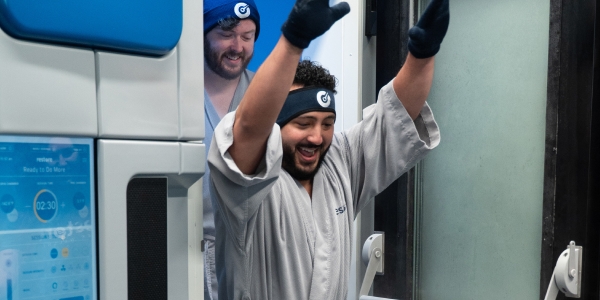
When you arrive for your first session, you’ll complete a quick waiver. Our Wellness Rep will then take you back to our private changing rooms, where you'll get ready. Don’t worry—we provide all of the protective wear you’ll need, including hat, socks, slippers and gloves.
From there, they will walk you through your three-minute session step by step and stay by your side throughout the entire experience. You’ll even have the option to choose your own “help me get through this” song.
If it’s your first time and you’re not sure you can last the full three minutes just yet, that’s absolutely okay. We can help you build your cold tolerance safely and gradually over multiple sessions.
Cryotherapy Chambers Designed for Superior Experience
Restore’s Cryotherapy Chambers are proprietary and designed exclusively for our studios. Unlike other two-person chambers on the market that reach around -126°F, our 2COOL and 4COOL chambers achieve much colder, optimized temperatures -157°F and -166°F, respectively. That means you can bring a friend or loved one for a shared session in a 2COOL or 4COOL chamber, or try our single-person 1COOL chamber, available exclusively in select locations.
But it's not just the temperature that makes our Cryo Chambers unique. They also include Alexa-enabled music control, a two-way communication system, a pre-chamber that maintains visibility while keeping consistent sub-zero temperatures and customizable cold levels (beginner, intermediate, and advanced), allowing you to tailor the experience to your preferences.
Use Cryotherapy as a Recovery Tool Within Your Wellness Strategy
We approach wellness a little differently at Restore. Our unique methodology is built on the idea that when you bring nine key elements, like cold, heat, hydration and oxygen together and use them synergistically, you can help optimize both your body and mind.
While research proves Cryotherapy can be a powerful treatment on its own, in our experience, it’s when you pair it with our other Restore Therapies that things really start to get very interesting.
You may notice faster recovery, better energy and results that feel more targeted to your goals. For example, combining Cryotherapy treatments with IM shots such as Lipo + B12 can help boost your metabolism and support fat-burning while enhancing overall energy levels.
Some of our favorite ways to stack Cryotherapy include:
- Before Compression Therapy
- Before IM Shots
- After IV Drips
- After Infrared Sauna
- After Red Light Therapy
So, overall, is Cryotherapy worth the investment? The science says yes.
Numerous studies highlight that Cryotherapy shows great potential in supporting your body’s natural repair systems for recovery and overall well-being.
In other words, Cryotherapy isn’t just a performance tool for professional athletes; it’s a powerful addition to a balanced wellness routine.
At Restore, our team can help you design a personalized Wellness Plan that aligns with your specific wellness goal. Together, we can figure out exactly where Cryotherapy should fit into your routine for optimal results.
Ready to see and feel the difference Cryotherapy can make to your health? Book a session at your nearest Restore studio today.
FAQs for Cryotherapy Benefits
How often should I do Cryotherapy to see results?’
According to Dr Rachele Pojednic, the Chief Science Officer at Restore, “our data shows that the more consistent you are with Cryotherapy, the stronger and more lasting the anti-inflammatory and metabolic effects.”
The good news is you can safely come for Cryotherapy up to twice a day.
The only thing to keep in mind is that your body does need to return to its normal temperature (above 80°F) before your second session. So, as tempting as it might be to jump straight back into the cold, we recommend giving your body a bit of time to warm up and reset.
How soon will I feel the benefits?
The benefits of Cryotherapy can be felt almost immediately after you step out of the Cryo Chamber. That’s because the extreme cold can help trigger a surge in norepinephrine and dopamine. This natural response not only gives you that post-session “high,” but can also help to clear your mind and lift your mood.
What’s the difference between Whole Body and Local Cryotherapy?
Whole Body Cryotherapy exposes your entire body to sub-zero temperatures to trigger a full-system recovery response. On the other hand, Local Cryotherapy targets specific areas, like sore joints or muscles. This offers more focused pain and inflammation relief.
How does Cryotherapy compare to an ice bath?
Both Cryotherapy and ice baths use cold exposure to support athletic recovery and well-being, but the key difference is in intensity and efficiency.
While ice baths rely on water temperatures around 50–59°F, Cryotherapy exposes your body to ultra-cold air as low as –166°F. That means that you may have to spend up to 10 minutes in the ice bath to try and achieve the same level of cold you can get in a Cryo Chamber in just two to three minutes.23,24
There’s also the control factor. In an ice bath, your body heat warms up the surrounding water, so it’s harder to keep the temperature consistent. In contrast, Cryotherapy allows for much more precise temperature control as Cryotherapy chambers can maintain the same degree of cold throughout your entire session.


%20A%20Better%20Way%20to%20Give%20Your%20%E2%80%A8Body%20NAD%2B.jpg)