
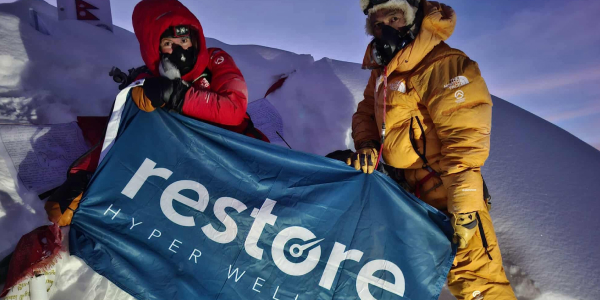

Highlights
- An athlete’s odyssey: At 36, Megan Rath hiked to Everest Base Camp on a whim. By 45, she was standing atop Mt. Manaslu, the world’s eighth‑highest peak (26,781 ft), while juggling a demanding career and a history of knee surgeries.
- The Restore advantage: Megan credits consistent use of Cryotherapy, Compression, Red Light Therapy, Infrared Sauna, IV Drip Therapy and Niagen (NR) sessions for keeping inflammation and pain at bay, helping her train smarter and recover faster.
- Small steps, big results: Instead of chasing quick fixes, Megan built a sustainable routine—focusing on one new therapy at a time and stacking them as her body adapted. That incremental approach mirrors what Restore recommends: start with one and stay consistent.
- Ready isn’t a feeling; it’s a decision: Whether you’re climbing literal mountains or tackling day‑to‑day goals, Megan’s mantra remains the same. With the right tools and support, your body can do more than you think.
Climbing Higher: From City Streets to the World’s Tallest Peaks
Megan’s passion for mountaineering began by chance. In 2016, between jobs, she decided to trek to Everest Base Camp—a spontaneous move that would reshape her life. “I met this incredible woman who told me, ‘Start small,’” Megan said. “So I climbed Kilimanjaro. Then one mountain led to the next.”
From Kilimanjaro to Denali, Elbrus, Aconcagua, Vinson, and Everest, she ultimately completed the Seven Summits, the highest peaks on every continent. Each climb demanded new skills, greater strength and smarter recovery.
By 2020, after years of pushing her limits, Megan realized her “tough it out” mindset was no longer enough. Collegiate lacrosse and field hockey, a decade of squash and multiple Ironman triathlons had taken their toll. Chronic pain and four knee surgeries left her facing a choice: pull back or find a better way to recover.
She discovered Restore Hyper Wellness during the pandemic. Her first visit to a Charleston studio was for Cryotherapy, a two- to three-minute exposure to sub-zero temperatures. The relief was immediate—swelling decreased and movement felt easier. “I was instantly hooked,” she recalls.
She added Compression, Red Light Therapy, Infrared Sauna and, later, IV Drip Therapy and Niagen (NR). Each therapy addressed a specific need: inflammation control, circulation, tissue repair, stress reduction or cellular energy.
“At 45, I felt the strongest and healthiest I’ve ever been,” she said. “That didn’t happen overnight—it was years of small, consistent work stacking up.”
Despite her training schedule, Megan never stopped being an executive. As vice president of a medical technology company, she often logs 50-hour weeks. Restore’s flexible appointments and fast sessions allowed her to fit recovery into her routine: between meetings, while working on her laptop, even during travel. She continued Cryotherapy and Compression on business trips to reduce swelling and stay ready for her next climb.
Building a Strong Foundation: Training & Recovery
Preparing for a 26,781‑foot summit while managing multiple knee surgeries required discipline. Megan built her program around load management, training six days per week with one day of rest. Because she lives in Philadelphia, most of her workouts happen indoors on a stair mill or bike, supplemented by swimming, strength training and rucking (walking with a weighted pack).
She also focused on staying in zone two (aerobic effort) for about 80% of her workouts to build endurance without overtaxing her joints. Rucking sessions gradually increased from 15 to 30 pound packs and from one hour to three and a half hours, with short breaks for hydration and snacks. Between workouts, she made mobility and flexibility a daily priority.
Through all of that training, Megan learned that the climb is won long before base camp. “I’m not a world-class athlete—I’m an amateur doing extraordinary things because I’ve stuck with it,” she said. “All of these therapies added value to my life and my longevity as an athlete.”
Cryotherapy
Megan booked at least two sessions each week to control inflammation and swelling. RestoreLabs research shows that completing six or more Cryotherapy sessions per month reduces systemic inflammation and may improve metabolic markers.
Compression Therapy
Restore’s NormaTec 2.0 Compression boots helped mobilize fluid and improve blood flow after long flights, heavy training or extended standing. Compression enhances blood flow and delivers more oxygen and nutrients to recovering tissues.¹
Red Light Therapy & Infrared Sauna
Megan alternated between quick 10‑minute Red Light sessions and 30‑ to 45‑minute Infrared Sauna sessions to support tissue repair, circulation and stress reduction. Red Light Therapy uses low levels of red and near‑infrared light to promote cellular energy and reduce inflammation2, while Infrared Sauna penetrates deep into tissues3 to activate heat‑shock proteins and boost immunity.
IV Drip Therapy & Niagen (NR)
Weekly or biweekly IV Drips provided hydration and essential vitamins, minerals and amino acids. Unlike oral supplements, IV Drips deliver nutrients directly to the bloodstream for 100% bioavailability. Megan often added Niagen (NR), a precursor to NAD⁺, to her Drips. Niagen may increase NAD⁺ levels by about 20% within three hours and offers faster infusion times than NAD⁺ IV.
“Niagen is a long-term play,” Megan explained. “It supports sleep, focus and endurance from the inside out.”
Mild Hyperbaric Oxygen Therapy
On lighter days, she relaxed in a Mild Hyperbaric Oxygen Chamber, breathing pressurized oxygen to help repair tissue, support immunity and improve mood.4
Megan also credits consistency and sleep for her resilience. “All of this only works if you’re consistent,” she said. “And nothing replaces good sleep—it’s your superpower.”
Summiting Mt. Manaslu: A Flash Ascent
Megan’s Manaslu expedition in Nepal was not a typical climb. With limited vacation days, she chose a “flash expedition,” a fast, high-risk ascent designed to minimize time at altitude. In just two days and six hours, her team reached the 26,781-foot summit.
“It was mentally and physically brutal,” she said. “You’re moving slow but constantly. You have to break it down. One hour, one step at a time.”
After nearly 24 hours of climbing and descending, Megan returned safely to base camp, exhausted but uninjured, a first in her career. “This was the first climb where I had zero setbacks,” she said. “No swelling, no pain, no inflammation flare-ups. I truly believe it was everything I did at Restore that kept me strong.”
Her mantra carried her through the hardest stretches: “Ready isn’t a feeling, it’s a decision.”
Her mental strategy mirrored her physical one: break the goal into small, manageable tasks. When the summit felt far away, she focused on taking the next step or making it to the next hour. Support from Sherpa partners and teammates helped her stay present and safe.
Recovering and Thriving: Back to Base, Back to Restore
Within 48 hours of landing in Philadelphia, Megan was back in a Restore studio. “My first stop was an IV Drip,” she said. “Then Compression every day that week. My body was in shock, but I bounced back faster than ever.”
It wasn’t just recovery, it was part of the same rhythm that had helped her reach the summit. “Start with one thing,” she said. “You don’t need to do everything. Pick one Therapy, stay consistent and get one percent better every day. That’s how big goals are built—one small decision at a time.”
By listening to her body and leaning on her Restore routine, Megan returned to training within two weeks. She notes that she recovered faster than after previous climbs and experienced less post‑expedition fatigue.
Build Your Own Wellness Stack
Megan’s story shows that elite feats aren’t reserved for professional athletes. Whether you’re training for a marathon, hiking your first trail or simply aiming to feel better, you can start with one therapy and build from there.
Start With One Thing
Choose the therapy that addresses your most pressing need. If inflammation or pain is holding you back, Cryotherapy may help. For tight muscles and sluggish circulation, Compression or Red Light Therapy is quick and convenient.
Stay Consistent
The science, and Megan’s experience, show that results come from frequency. Completing at least six Cryotherapy sessions per month is linked to lower systemic inflammation.5 IV Drip Therapy works best when nutrients are replenished weekly. Niagen Plans help maintain optimal NAD⁺ levels over time.
Hydrate and Nourish
Proper hydration and nutrient intake are the foundation of recovery. IV Drips ensure full absorption of vitamins, minerals and amino acids.
Listen to Your Body
Pair training with rest and mobility work. Use Zone 2 training to build endurance without overstressing joints, and let recovery sessions be non‑negotiable. If you’re pressed for time, 10‑minute Red Light Therapy or 30‑minute Compression sessions can make a noticeable difference.
Find Your Community
Megan leaned on Restore’s community, staff, nurses and fellow Members to stay accountable and motivated. She also joined “Know More, Do More” webinars (like the session that inspired this article) to learn from experts and connect with other members. Membership unlocks exclusive events, guest passes and preferred pricing.
Ready to Start Your Journey?
Megan’s ascent of Mt. Manaslu is a testament to what’s possible when dedication meets science‑backed recovery. You don’t need to summit an 8,000‑meter peak to benefit from these therapies. Whether you want to reduce pain, improve performance or simply feel your best, Restore’s team can help design a Wellness Plan that fits your goals and schedule.
Find your nearest studio and book an appointment to get started.


