
You may have seen at-home red light LED masks on the market, but how do they stack up against professional, in-studio Red Light Therapy?
Red light masks are designed to be worn on the face to promote collagen production and younger-looking skin. They are tuned to a lower intensity for safe, frequent use. In contrast, Red Light Therapy uses clinical-grade panels to deliver red and near-infrared light (NIR) at a much higher intensity to the whole body. In addition to smoother skin, it supports improved mood, faster recovery, and reduced pain and inflammation.1
In this article, our experts compare red light LED masks and Red Light Therapy at Restore to help you achieve the best results for your skin.
Highlights
- At-home red light masks improve skin but mostly target surface layers.
- Professional Red Light Therapy reaches deeper tissues and provides better skin, muscle, circulation and mood benefits.
- Higher-intensity, full-body Red Light Therapy delivers faster, more noticeable results.
- Expert-guided Red Light Therapy sessions can be personalized, while the masks are set to a default intensity.
What Are Red Light LED Masks?
Red light masks are wearable devices designed for at-home use. They emit low-level red light wavelengths (typically around 630nm) to the skin, which can stimulate cellular activity and collagen production in the epidermis and the upper dermis.2
Often used for skin rejuvenation, these masks are popular for their convenience and non-invasive nature. However, effectiveness largely depends on light wavelength and intensity, which vary significantly with device quality.
Some red light masks also incorporate near-infrared light wavelengths (around 850 nm), which penetrate deeper tissues in the skin. This light activates the mitochondria, triggering enhanced tissue repair and reduced skin inflammation.2 As inflammation is linked to collagen breakdown, lowering it can further improve skin integrity.3
A study found that participants using a mask combining red and near-infrared light saw noticeable reductions in crow’s feet wrinkles after 16 weeks.2
These masks are typically used to help with:
- Reducing fine lines and wrinkles
- Improving skin tone and texture
- Minimizing redness and inflammation
- Boosting overall skin radiance
While red light LED masks are popular at-home tools, their capabilities are somewhat limited by their design and power output.
Our Experts Weigh In: What Dr. Legere Says About LED Masks
Dr. Henry Legere, the Chief Medical Officer of Restore Hyper Wellness, explains the effectiveness of red light LED masks but notes that they primarily target the outermost layer of the skin.
“While at-home devices can be effective, they are most useful for maintenance and for mild to moderate skin concerns. They help somewhat with reducing fine lines and wrinkles, improving skin tone and texture, reducing inflammation and enhancing wound healing. However, for more profound changes, penetration into the dermis is required and LED masks typically do not achieve this.”
While LED masks are great for surface-level concerns, they may not be powerful enough to trigger the deeper skin transformation you’re looking for. This is where professional Red Light Therapy comes in.
What is Red Light Therapy and How Does It Work?
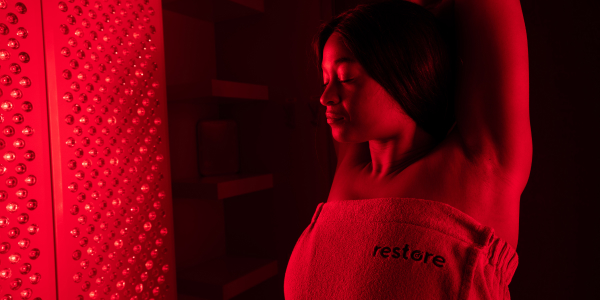
Red Light Therapy is a non-invasive treatment that uses high-intensity red and near-infrared light to penetrate deeper into the body’s tissues. Both of these lights are absorbed by the mitochondria in different skin layers, contributing to different therapeutic outcomes.
Red light primarily stimulates mitochondria in the upper layers of the skin, nudging it to produce more collagen and elastin. This supports skin repair, improves skin texture and reduces visible signs of aging.4
Near-infrared light (NIR) penetrates deeper into the muscles, signaling the mitochondria to produce more cellular energy (ATP). This allows cells to perform functions like tissue repair more effectively, leading to faster recovery and reduced pain.4
Red Light Mask vs. Red Light Therapy: A Side-by-Side Comparison
While both at-home red light masks and professional Red Light Therapy rely on the same underlying mechanisms, they differ greatly in application and outcomes. Here’s what you should consider before choosing one over the other:
Power and Intensity
Both masks and Red Light Therapy use red light wavelengths in the range of 630–880 nm, but at very different intensities. The difference in irradiance (or the amount of light delivered to the body per square centimeter over time) clearly illustrates this.
At-home red light masks typically deliver irradiance in the range of 5–30 mW/cm². This low output limits potential issues like overheating, making the mask safe to use unsupervised at home. In contrast, professional Red Light Therapy panels commonly deliver an irradiance of 100–250+ mW/cm²—up to 10-15 times higher than at-home solutions.
Coverage Area
Another reason why Red Light Therapy is superior is that its benefits extend far beyond the face. Many whole-body benefits are simply unattainable with a device that focuses on only one area.
Even if your goal is to improve your skin's appearance, note that the mask will only target your face, while a Red Light Therapy session can support uniform skin improvements across the body.
Depth of Penetration
While some red light masks combine red light and near-infrared light, many only use red light. As red light usually reaches about 1–2 millimeters into the tissue, it mainly affects the epidermis and upper dermis, limiting its potential to trigger muscular recovery in deeper tissues.10
Near-infrared light, on the other hand, can penetrate up to a few centimeters of body tissue, allowing it to reach connective tissues and muscles effectively.10 Using both types of light is necessary to see the full benefits of photobiomodulation.
Types of Wellness Benefits
Red light masks primarily support surface-level cosmetic maintenance, such as improving skin tone and reducing fine lines, while full-body Red Light Therapy can help promote overall well-being.
By enhancing the cellular processes that influence all bodily processes, it can positively affect almost every area of your life.
Convenience vs. Consistency
While nothing beats the convenience of using a device at home, the trade-off is usually efficacy.
You’ll need to wear the mask multiple times to match the intensity of a single professional Red Light Therapy session. Some clients also report difficulty committing to 10-15 minutes for the ritual each day, and missing it even a few times can affect results.
With Restore’s Red Light Therapy, you get precise dosing and full-body coverage that at-home devices cannot reliably replicate. With just 2-5 sessions every week, you can reap whole-body benefits that improve your quality of life.
Guidance and Experience
With red light LED masks, you are left to your own devices. The light frequencies are set to default and can’t be customized for you, even if you can benefit from some curation.
At Restore studios, wellness is always curated to your needs. We understand that a one-size approach to health never works—that’s why each Red Light Therapy session is supervised by one of our experts who takes time to answer your questions and curate your experience. They’ll be happy to earnestly advise you on the intensity and frequency that will best support your health goals.
Cost Considerations
As the wellness benefits they offer differ greatly, they can’t be compared fairly on cost alone. Consider the outcomes you want to make an informed choice.
If you’re interested in incorporating Red Light Therapy for post-exercise recovery or to support your overall health, we highly recommend Restore Memberships. You get up to 30% off all therapies and packs, and can avail this exclusive pricing at any of our 210+ locations nationwide.
Red Light Therapy Benefits Aren’t Only Skin Deep
While red light masks only promise skin health benefits, research strongly suggests that professional Red Light Therapy sessions can also enhance overall health and well-being.
In the 1990s, NASA conducted a landmark study that demonstrated the effectiveness of photobiomodulation for wound healing and musculoskeletal recovery.5 Since then, multiple studies have confirmed that Red Light Therapy can:
- Improve energy levels
- Slow down cellular aging
- Reduce inflammation and pain
- Enhance circulation
- Improve mood and cognition
We discuss more details about these outcomes below.
Red Light Therapy May Help Boost Energy Levels
We discussed how photobiomodulation stimulates the mitochondria and boosts cellular energy levels. Although research is still inconclusive on how this can extend to overall energy levels, many people report feeling energized and refreshed after sessions.
Red Light Therapy May Help Relieve Minor Pain and Swelling
Both red light and NIR interact with cellular processes that help regulate inflammation and oxidative stress.1 As these contribute significantly to musculoskeletal pain, regulating them can effectively help manage chronic pain, too.1,6
It all starts with cytochrome c oxidase, a key component of mitochondria. It absorbs the light and triggers the release of reactive oxygen species (ROS). These act as messengers for nearby cells to release powerful antioxidants, like superoxide dismutase, catalase and glutathione, to counter free radicals and fight oxidative stress.1 In turn, they significantly reduce inflammation and enhance tissue repair.1
The results also support the science here. A study found that using photobiomodulation for 15 minutes twice a day over 10 days led to a more than 50% reduction in pain and disability scores in elderly patients with degenerative knee osteoarthritis.6
Red Light Therapy May Help Support Mood and Stress Balance
Emerging research shows a strong link between photobiomodulation and mood.
Near-infrared light reaches the mitochondria in neurons, promoting increased ATP production. This triggers signaling pathways that can reduce stress-related inflammation and improve the function of neural circuits involved in emotional balance.7
Red Light Therapy can also reset the circadian rhythm, the body’s internal clock that controls sleep-wake cycles, alertness and hormone release, which further supports emotional balance and well-being.7
Red Light Therapy May Help Support Recovery and Healing
We previously discussed how Red Light Therapy increases ATP levels and allows cells to perform their functions more effectively. This same mechanism also accelerates healing after exercise and injury.
Plus, Red Light Therapy also improves circulation. This allows nutrients and oxygen to be delivered quickly to the site of injury.9
Research also shows that photobiomodulation can stimulate collagen and blood vessel growth while lowering inflammatory markers—all of which are essential for healing and recovery.8
Why is Red Light Therapy More Effective for Skin Health?
Unlike LED masks, which typically work on the epidermis (outer skin layer), Red Light Therapy can reach the dermis, the deeper skin layer responsible for collagen production, elasticity and overall skin structure. This alone makes it more effective than LED masks for long-term skin health.
Because the light can reach the dermis, it stimulates collagen production and repairs damaged tissue at a cellular level. This leads to more significant improvements in skin texture, tone and elasticity and can also address more severe skin concerns, such as sun damage and deep wrinkles.
Another key advantage is the power of the red light panels used in professional therapy. At Restore Hyper Wellness, our Red Light Therapy panels are far more powerful than those found in at-home devices. This means each session delivers a stronger dose of red and near-infrared light, helping to enhance skin health more quickly and effectively.
Who Should Choose a Red Light Mask vs Red Light Therapy?
The choice between a red light LED mask vs clinical-grade Red Light Therapy boils down to your lifestyle and health goals.
When a Red Light Mask Makes Sense
If you want a convenient way to manage skin concerns like fine lines and wrinkles without going out of your way, a red light mask offers great value. It’s intended as an additional step in your skincare routine, rather than a full-scale solution for skin health.
Many clients also use these at-home devices in between professional Red Light Therapy sessions to maintain results.
When Red Light Therapy May Be the Better Choice
While red light LED masks can be useful for at-home maintenance, they simply do not provide the same level of skin transformation as professional Red Light Therapy.
The scope of each method is also quite different—one focuses on a single body part, while the other improves complete cellular health. Think of it this way: while one is a cosmetic solution, the other is a wellness one.
If your goal is to take your health to the next level, consider booking a Red Light Therapy session with us. With deeper skin penetration and higher-energy wavelengths, Red Light Therapy at Restore delivers more comprehensive results.
Invest in the best and give your skin the most potent red light experience for results that matter. Book your Red Light Therapy appointment today.
FAQs for Red Light Therapy vs. Mask
1. How long does it take to see results from Red Light Therapy?
Results may vary based on session frequency and your current health status. Many clients report feeling energized and getting some relief from inflammation or pain after their first session. Visible skin improvements and other changes may take 4-6 weeks to become noticeable.
2. How often should I do Red Light Therapy to support skin or wellness goals?
Typically, 2–5 sessions per week of Red Light Therapy are recommended, depending on the desired health outcomes.
3. Can I combine the mask with Red Light Therapy?
Red light masks are great for at-home touch-ups between professional sessions. To prevent potential overexposure, avoid using red light masks the same day as Red Light Therapy sessions.
4. Does Red Light Therapy use the same wavelengths as red light masks?
Both use red and near-infrared lights, but professional Red Light Therapy delivers stronger intensity and deeper penetration for more comprehensive effects.
Medical services are provided by an independently-owned physician practice. Some services may require medical clearance and a prescription. We reserve the right to refuse service to anyone. Services, therapies, ingredients and prices may vary per location. The content on our site, blog posts, educational materials, apps, promotional newsletters and any other written content are not intended to replace an evaluation with a qualified healthcare professional and are not intended as medical advice.