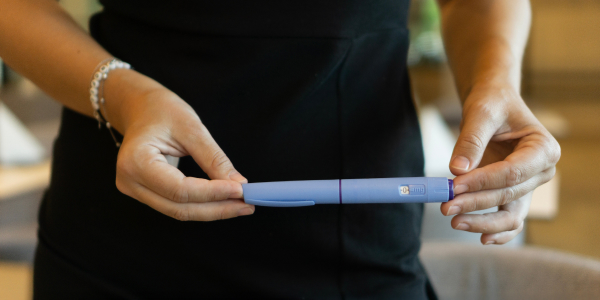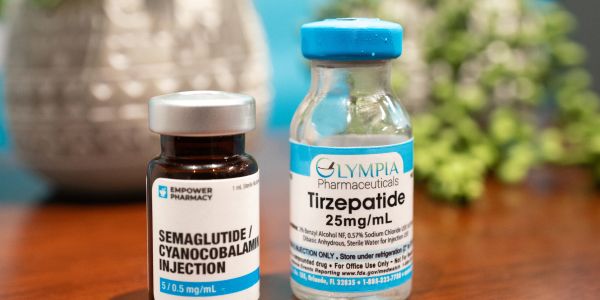

Tirzepatide and semaglutide are both effective medications for weight loss, but they work in different ways.
Numerous clinical trials and real-world studies have demonstrated the effects of both medications, not only on weight loss but also on other key health biomarkers, such as blood glucose levels.
When choosing which medication is best for you, it’s important to consider how each works and any possible side effects. The most suitable choice often comes down to individual goals, sensitivity and health history. So make sure you discuss your options with a licensed medical professional.
In this article, we’ll compare semaglutide and tirzepatide side-by-side to help you better understand how each drug works, along with potential benefits and side effects.
Highlights
- Semaglutide and tirzepatide work by mimicking naturally occurring hormones to suppress appetite and stabilize blood sugar.
- Semaglutide works by activating the GLP-1 pathway.
- Tirzepatide works with GLP-1 and GIP, making it a dual-pathway agonist.
What Is Semaglutide?
Semaglutide is a prescription medication approved by the FDA to help manage type 2 diabetes (Ozempic) and to support long-term weight loss (Wegovy).
Semaglutide can be incorporated into personalized weight management plans, including clinically prepared compound medications such as those on our GLP-1 Plans, to help clients achieve meaningful results.
Semaglutide is a glucagon-like peptide-1 (GLP-1) receptor agonist. This means it mimics the GLP-1 hormone by binding to its receptors across a range of different cells, which is why it has been shown to be effective for a range of uses.
Think of the receptor and the peptide like a lock and key—once connected, the semaglutide “unlocks” the cell, prompting it to act. This could be to produce another hormone or suppress appetite.
How Semaglutide Works (GLP-1 Agonist)
Semaglutide supports weight loss by curbing appetite and regulating blood sugar, making it easier to burn fat. It works by activating GLP-1 receptors in key areas like the gut, pancreas and brain to create a multilayered approach to weight loss.
The medication stimulates brain receptors that reduce appetite, making users feel less hungry and crave less. It also slows gastric emptying by delaying the transit of food into the small intestine, helping maintain blood glucose stability and prolong satiety.
In addition to suppressing appetite, semaglutide also regulates blood sugar levels. It prompts the body to release insulin, allowing cells to use glucose as an energy source, while reducing glucagon, a hormone that signals the liver to release stored glucose. When blood sugar levels are stable, excess glucose is not stored as fat, and the body burns fat more effectively, both of which support weight loss.
Dr. Rachele explains why additional supplementation, such as via GLP-1 medication, helps to achieve these benefits. “GLP-1 is only secreted in very small amounts when you eat, with a short half-life as well. In essence, it doesn’t stick around in the bloodstream for that long. These GLP-1 medications are modified to be a much larger dose than you would ever be able to secrete by yourself. Plus, they remain in your system for about a week before it starts to wear off.”
Research Insights on Semaglutide and Weight Management
Semaglutide has been shown to produce substantial and sustained weight loss among users. The first STEP trial (a series of large clinical trials that investigated who semaglutide helps and in what context) reported a 14.9% reduction in body weight over 72 weeks for participants taking 2.4 mg weekly.1
A review article of multiple randomized controlled trials reports an average weight loss of around 16% among users, with some losing as much as 17.4%.2 It also shows improvements in other health markers such as blood glucose levels and body fat.
Weight loss has been seen to increase with higher dosages. One trial showed participants taking 7.2mg weekly losing on average 18.7%, with many reaching 20-25% weight loss thresholds.3 However, gastrointestinal side effects increased with high dosage.3
One study (an extension of the original STEP-1 trial) also showed that participants regained two-thirds of their weight after discontinuing semaglutide, suggesting that maintaining weight loss may require long-term use.4.
Common Side Effects and Considerations
Common side effects include mild-to-moderate gastrointestinal symptoms. In one trial, nausea and diarrhea were the most common side effects. Participants also reported vomiting and constipation.1 These were mostly mild symptoms that resolved quickly; however, some participants discontinued the trial as a result. Side effects tend to increase with dosage.3
What Is Tirzepatide?
Tirzepatide was initially approved for type 2 diabetes (Mounjaro), and it is now also approved for long-term weight loss in adults with obesity or overweight with weight-related health conditions (Zepbound).
Tirzepatide is an excellent choice for personalized weight management programs, including clinically prepared compound medications such as those in our GLP-1 Plans, helping clients manage weight effectively.
Tirzepatide is a dual incretin receptor agonist, meaning it activates both the glucagon-like peptide-1 (GLP-1) receptor and the glucose-dependent insulinotropic polypeptide (GIP) receptor. By targeting two metabolic pathways instead of one, tirzepatide supports appetite regulation, blood sugar control and metabolic efficiency through complementary mechanisms.
Think of this as a two-key system rather than a single lock and key. When tirzepatide binds to GLP-1 and GIP receptors, it sends coordinated signals that can reduce appetite, slow gastric emptying and improve insulin response—working together to enhance overall metabolic outcomes.
How Tirzepatide Works (Dual GIP/GLP-1 Agonist)
Tirzepatide mimics two peptide hormones: GLP-1 and GIP. They do similar but slightly different, complementary things. While GLP-1 helps regulate appetite and stomach emptying, GIP helps regulate insulin sensitivity and may balance the nausea effect caused by GLP-1.
“GIP slightly promotes fat storage, but this helps regulate metabolism and improve insulin sensitivity,” explains Dr. Rachele. “These drugs signal cells to pull glucose out of the bloodstream and store it safely, where it can later be burned for energy. Excess glucose circulating in the blood causes damage.”
Research Insights on Tirzepatide and Weight Management
In one clinical trial, participants receiving weekly tirzepatide lost significant weight, with the percentage loss increasing with dose. After 72 weeks, participants taking 5mg per week lost 15% of their body weight on average, with many dropping over 20% at the highest dose of 15mg.5
In a large, real-world observational study of more than 20,000 individuals, an average of 11% weight loss was observed at six months.6 Typically, titration (staggered dose increases) was slower compared to clinical trials.
Some studies comparing tirzepatide and semaglutide over 72 weeks found that tirzepatide was more effective in reducing body weight and waist circumference.7
According to Dr. Rachele, tirzepatide’s unique way of working offers additional levers for weight loss. “That dual-agonist approach is likely why tirzepatide consistently outperforms single-pathway GLP-1 therapies in clinical trials,” explains Dr. Rachele.
Common Side Effects & Considerations
Common side effects are similar to semaglutide and include nausea, vomiting, diarrhea and constipation. One clinical study found that these tend to be mild to moderate, occurring primarily when dosage levels increased from 5 mg to 10 mg/15 mg.5 However, some participants who experienced side effects discontinued the medication, even though tolerability is acceptable for most people.5
There is some evidence to suggest that GIP could reduce side effects from GLP-1 drugs, however, these findings are from animal studies.8 Clinical trials have not shown that GIP reduces GLP-1 side effects.9
Semaglutide vs. Tirzepatide: A Side-by-Side Comparison
Both semaglutide and tirzepatide are effective at aiding weight loss and improving specific metabolic markers. However, tirzepatide’s dual-pathway mechanism means it consistently outperforms single-pathway equivalent drugs in head-to-head trials.
Why Tirzepatide Might Be The Best Option for Weight Loss
Tirzepatide’s dual action on GLP-1 and GIP gives it the edge when it comes to weight loss effectiveness. This is because both GLP-1 and GIP are incretin hormones, which are released by the gut after eating.
They work in similar ways but also complement each other to support effective weight loss and potentially mitigate side effects.
GLP-1 helps regulate appetite and gastric emptying. GIP also does these things, although less effectively than GLP-1; its real value comes from improving insulin sensitivity and supporting efficient energy use.
How Restore’s GLP-1 Plans Support Safe, Personalized Progress
Clinician-Led Oversight From Start to Finish
At Restore, our approach is grounded in robust data-driven insights, screening and ongoing check-ins.
Before starting the medication, clients will have a consultation to discuss options, check eligibility and receive a personalized plan. Throughout the program, clients have meetings with our Nurse Practitioner to ensure their weight loss is safe and effective.
Flexible Dosing Through Compounded GLP-1 Medications
At Restore, our compounded medications allow us to adjust dosing levels to suit each individual’s needs. Rather than using prefilled pens, we can customize medication blends based on an individual’s goals, tolerance and biomarkers.
Whole-Body Wellness Options to Support Your Journey
In addition to GLP-1 compounded medications, we offer a range of science-backed therapies that can complement your weight-loss journey, including Infrared Sauna, Cryotherapy and Red Light Therapy. These therapies can enhance your results and improve your overall well-being.
Start Your Personalized Journey With Restore
Semaglutide and tirzepatide are effective weight loss medications—but in different ways. While semaglutide works on the GLP-1 pathway, tirzepatide uses GLP-1 and GIP to exert its effects. Research on both medications continues to show promising results; however, tirzepatide outperforms semaglutide due to its dual-pathway action.
When it comes to selecting the right choice, a one-size-fits-all approach doesn’t always work. Personalization through compound medications that align with an individual’s needs and treatment goals is often the best route.
Explore Restore’s GLP-1 Plans and start your personalized journey today.
FAQs
1. Are Tirzepatide and Semaglutide used for weight loss?
Both tirzepatide and semaglutide are used for weight loss. Randomized clinical trial data have shown that both medications lead to significant weight loss.
2. Are compounded GLP-1 medications the same as FDA-approved versions?
Compounded GLP-1 medications are not FDA-approved; however, the primary active ingredients in our products, semaglutide and tirzepatide, are the same as those in FDA-approved drugs. Restore’s supply chain team has verified that our partner pharmacies use active ingredients consistent with those in well-known FDA-approved weight-loss medications.
3. Why do people respond differently to GLP-1 medications?
Some GLP-1 medications, such as semaglutide, act through a single receptor, whereas tirzepatide also acts through GIP. In head-to-head clinical trials, tirzepatide has outperformed semaglutide.
There is also an individual patient response. There are a variety of reasons why people respond differently to GLP-1 medications, including demographic, body composition, health, lifestyle and environmental factors.10 Women tend to lose more weight than men when using GLP-1 medications. This is believed to be down to body composition, as women typically have a higher body fat percentage and female-specific hormones, which may interact with the drug differently.
4. How does Restore monitor progress?
At Restore, our clients have access to ongoing clinical care with Nurse Practitioners and an in-studio Registered Nurse team to help track progress. We also provide body composition analysis with InBody Scans.